The Kinova medical actuator series represents the most compact and integrated design in the medical robotics industry. Unlike standard industrial components, these actuators are engineered specifically for integration into medical robotic arms where space constraints, safety requirements, and performance demands are critical.
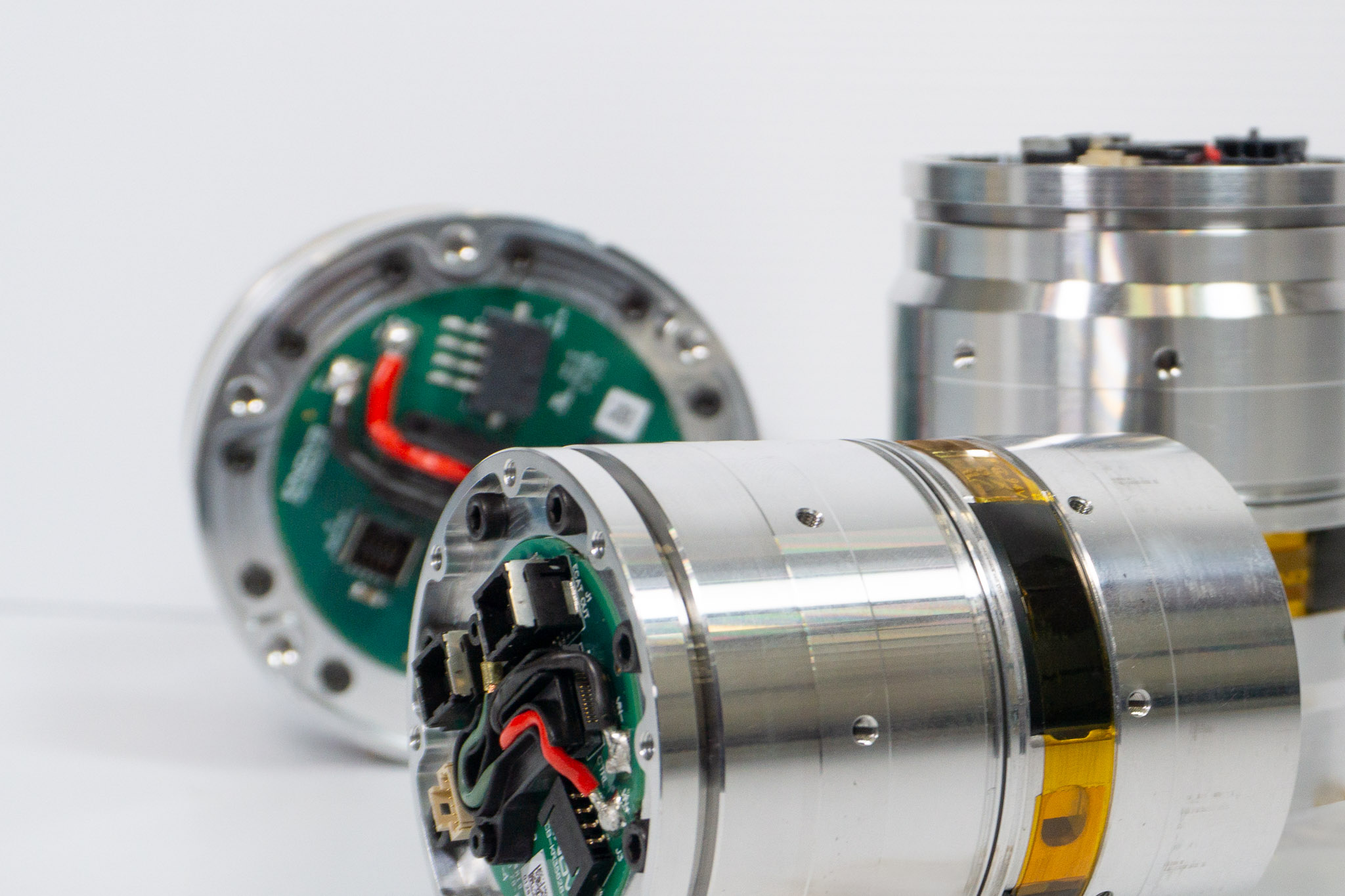
The KIMA actuator series includes a range of sizes from 65 mm to 110 mm to support various payload and torque requirements, with nominal torque from 12 Nm to 110 Nm and peak torque up to 217 Nm, while maintaining a consistent architecture and set of functionalities across the series.
Designed to meet medical safety standards such as IEC 60601-1 and IEC 62304 Class C, each actuator incorporates multiple safety features, including a dual-channel architecture and redundant torque sensors for enhanced safety and monitoring capabilities.
Using standardized EtherCAT/FSoE communication protocols and the CiA 402 drive profile, KIMA actuators support high-performance real-time control while simplifying integration into existing system architectures and reducing integration complexity for medical robotic applications.
It is a family of four actuators designed by Kinova for medical robotic arms. An actuator is the motorized joint (motor, gearbox, sensors and electronics) that moves each segment of the arm. All four models share the same architecture and functions.
ACT-65: 65 mm, 700 g, 12 Nm nominal and 36 Nm maximum torque. ACT-80: 80 mm, 1,150 g, 32 Nm and 70 Nm. ACT-90: 90 mm, 1,600 g, 55 Nm and 107 Nm. ACT-110: 110 mm, 2,900 g, 110 Nm and 217 Nm. Every model rotates through ±360°.
EtherCAT is a real-time industrial communication network that synchronizes all the actuators of an arm. FSoE (Fail Safe over EtherCAT) carries safety signals over that same network, so no separate safety wiring is needed.
CiA 402 is a standard way to command motor drives: the same commands and operating modes work across manufacturers. Engineers can drive Kinova actuators with tools and code they already know.
Each actuator uses a dual-channel architecture, meaning two independent channels check the same function, and has redundant torque sensors. If one channel or sensor disagrees with the other, the fault can be detected.
The Actuator Series is designed for IEC 60601-1, the safety standard for medical electrical equipment, and IEC 62304 Class C, the standard for medical device software. The final device is certified by the manufacturer that integrates the actuators.
Yes. The four models share the same architecture and functions, so they are integrated and controlled the same way whatever their size. You choose the diameter and torque that each joint of your arm needs.
Rely on actuators developed for medical environments where performance, safety, and integration are essential.
talk to our experts